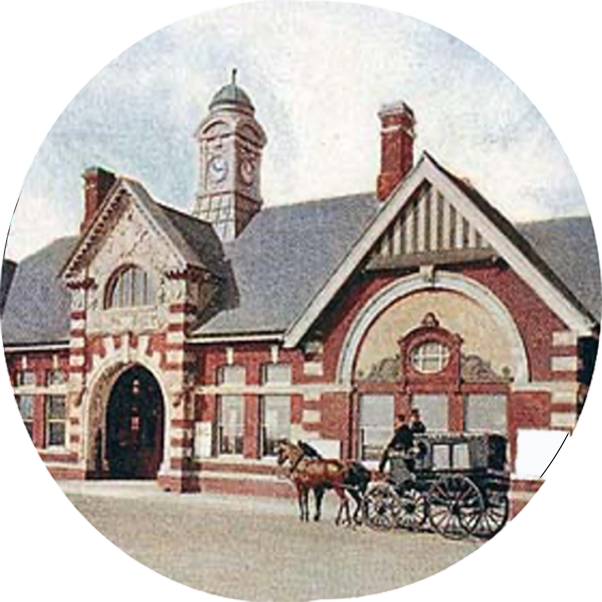
Model tramways have a problem that ordinary railways don’t. On a street tramway the track isn’t laid on sleepers and ballast. It is set into the road: grooved rail flush with the paving, with the groove itself carrying the wheel flange round every curve and through every junction. The track work is the road surface, and the road surface is the track work. It is one of the most characterful sights a layout can have, and one of the hardest to build convincingly.
TramIT! is my answer to that. It is a generator for grooved tram track set in the road, designed from the start to be 3D printed, and it works at any common modelling scale. This page explains what it does, shows three of its pieces of pointwork that you can try for yourself, and sets out where I hope to take it: first as a planning resource for tramway modellers, then as kits of parts from the Make It Miniature web store.
What TramIT! does
TramIT! produces road panels with the grooves already in them. The rail heads stand just proud of the road, as they do in the real thing. The panels join end to end with a key that works in either direction, so any panel fits any other. Because the trams run on batteries, there is no wiring, no rail joiners and nothing to insulate. You lay the road and the track is laid with it.
- Any scale, from real standards. Every dimension comes from the Tramway & Light Railway Society’s published scales and standards, covering 1:16 down to 1:148 and standard, metre and 3 ft 6 in gauges. Where the TLRS table is silent, TramIT! says so and shows where its own value came from.
- Grooves sized for model wheels. At small scales a true-to-scale groove would be far too narrow for model wheel flanges. TramIT! sizes each groove from the wheel standard and widens it on curves, following the same swept-flange principle the prototype engineers use.
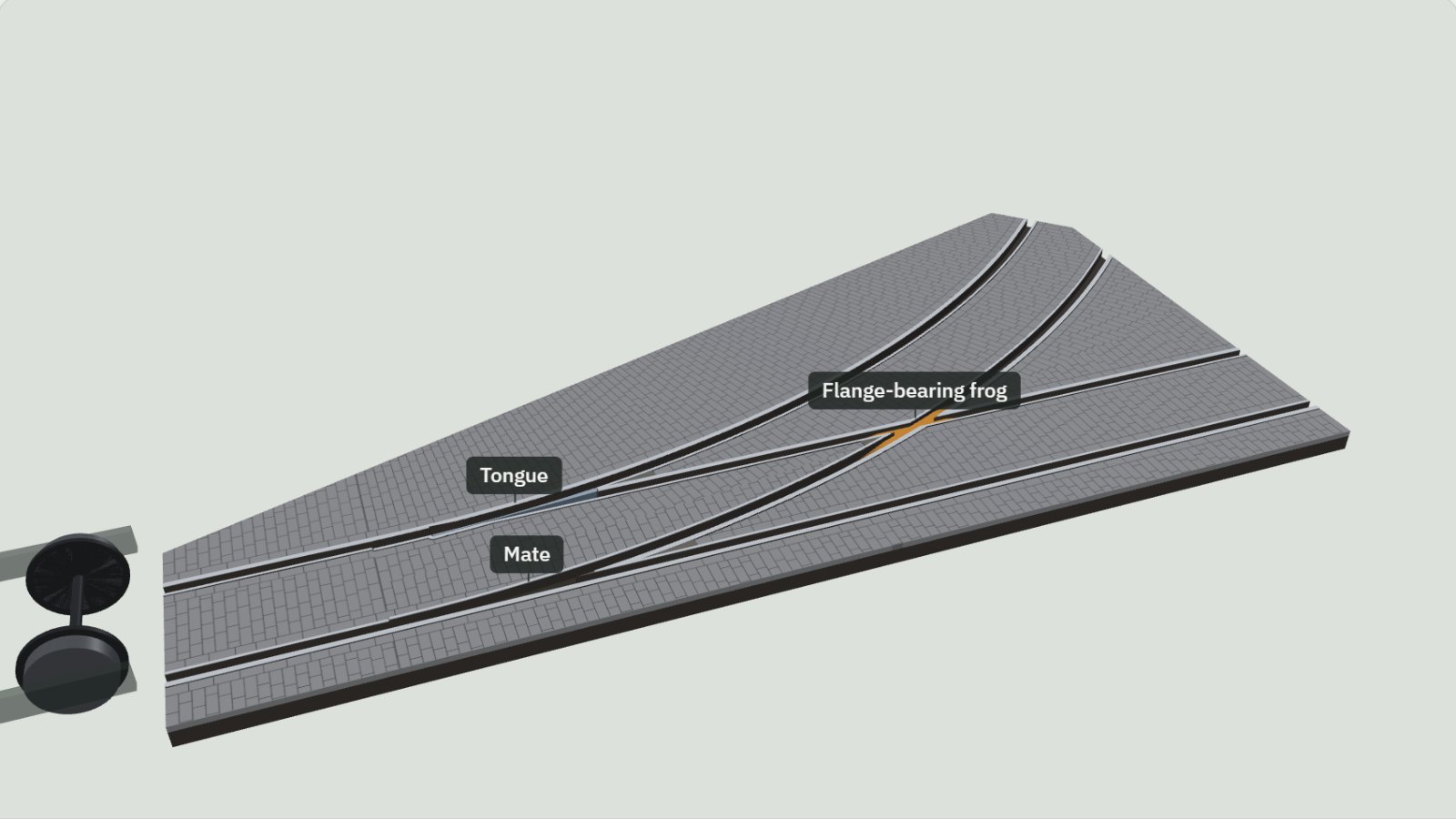
- Prototype pointwork. Tram turnouts don’t work like railway points. There is a single moving tongue on the inside rail of the curve, a fixed mate on the outside rail, and a flange-bearing frog, where the wheels cross on the tips of their flanges. TramIT! models all three, and the tongue can be sprung so a tram can trail through it.
- A choice of road surface. Print the road as it comes, or recess it for laser-cut plywood inlays scored as granite setts or wooden blocks. The cutting files are generated to match every panel.
Clearly, this approach will only work with battery powered models, but I am simultaneously working on a similar approach whereby standard model rail can be threaded into the 3D printed bases to cater for those who prefer (or are already committed to) to power their models through the rails.
Try it: interactive pointwork
The three pieces below are live 3D models of TramIT! parts in OO (1:76) standard gauge. Click a picture to load the model, then drag to turn it, set the road, switch the road surface, and press Run bogie to send a pair of wheels through. Each model is followed by notes and a table showing where every dimension comes from.
Turnout
A right-hand turnout on a 185 mm radius, in granite setts. Watch the tongue: set for the diverging road, its face lines up exactly with the lip of the curved groove and steers the flange into the curve.
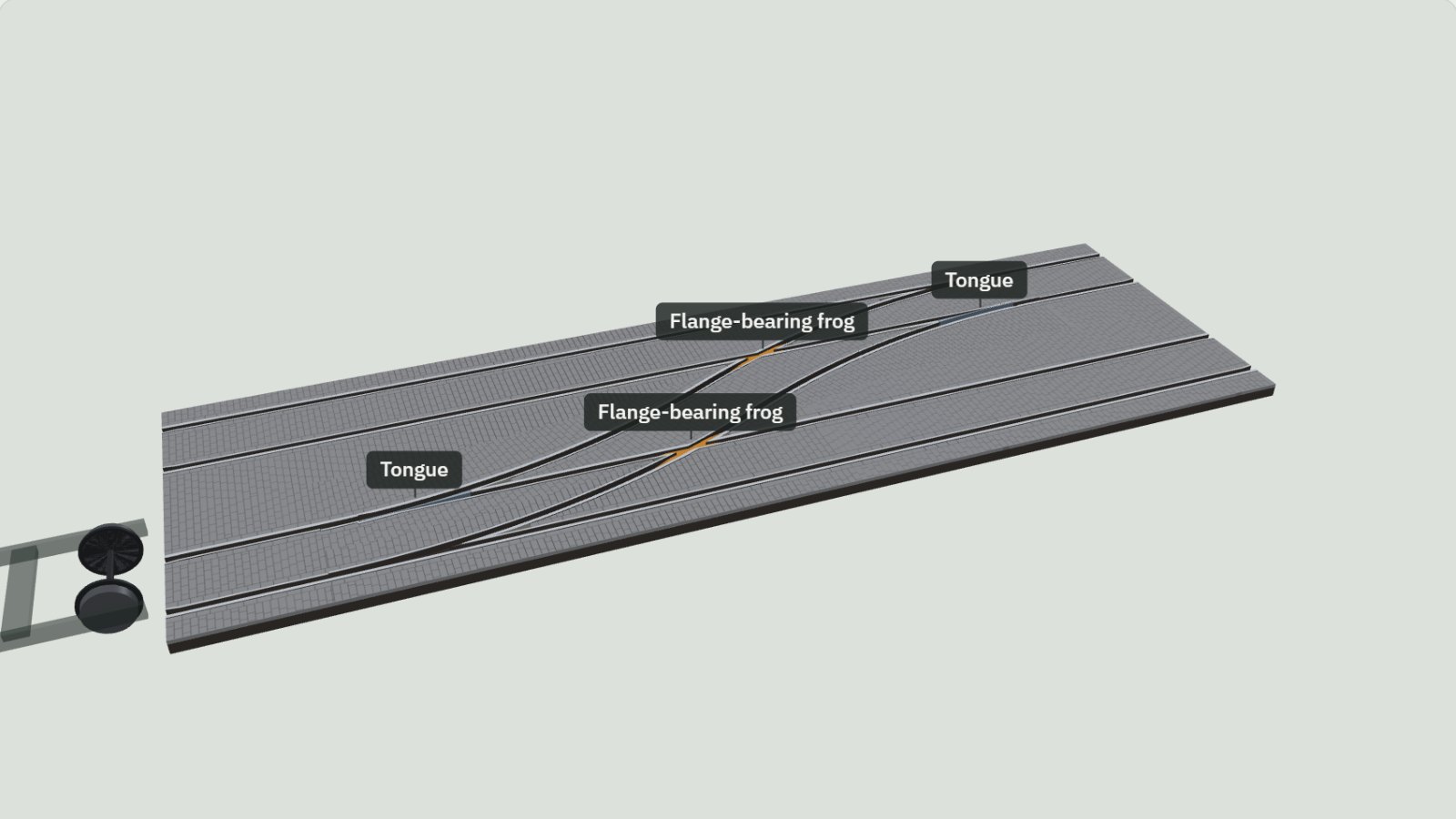
Crossover
A right-hand crossover between two tracks on the TLRS standard track centres (45 mm in OO). It is a reverse curve with a tongue at each end, made as one road panel with two loose tongues. Both tongues swing together when you set the road.
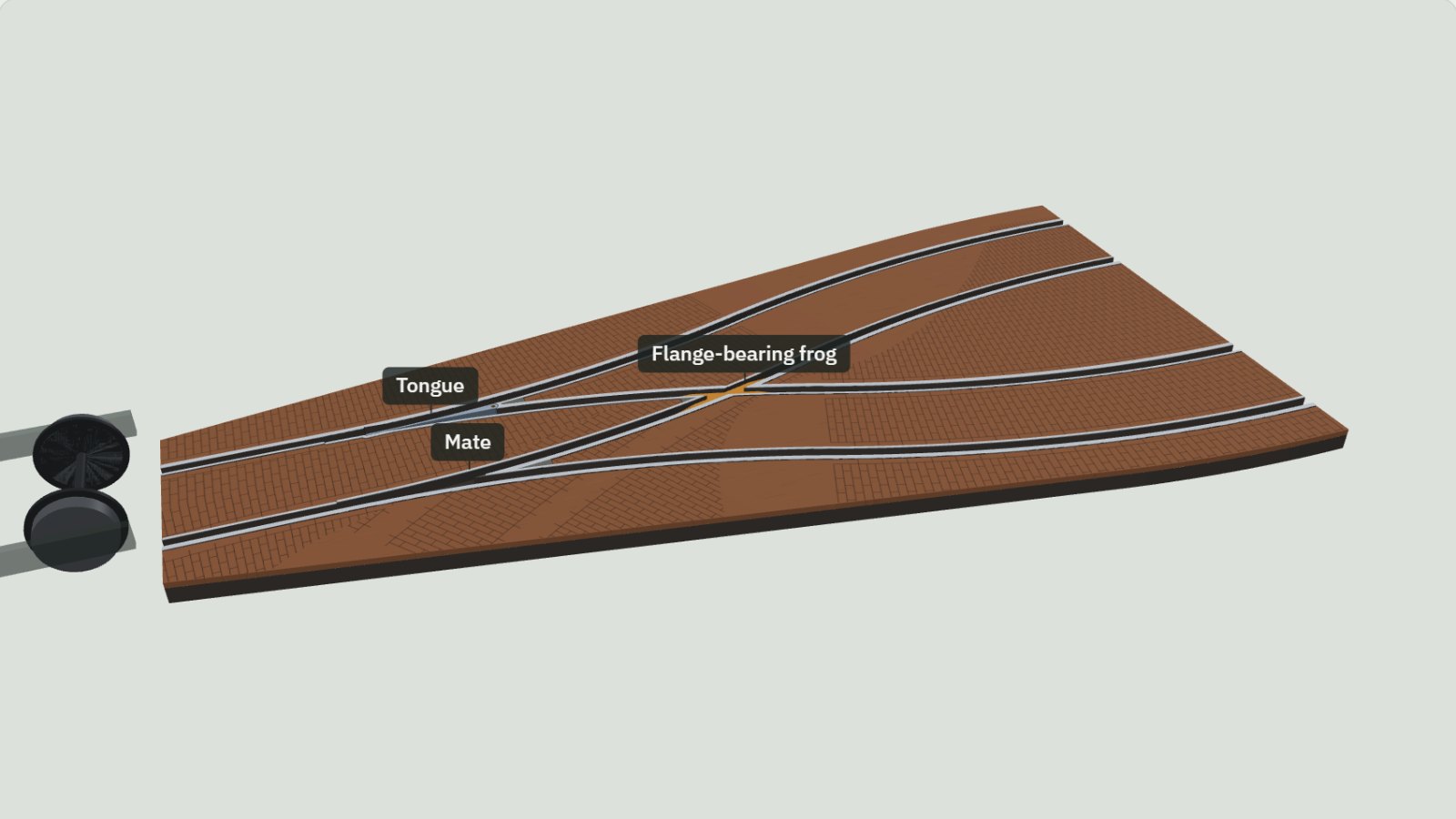
Y point for a passing place
A Y point that splits single track into a passing place, shown in wooden-block paving. Its return curves bring the two roads back parallel on the standard track centres. The tongue is sprung to hold the left road: a tram coming back through the right road pushes it over, and it springs home. Try Trail through from the right, then See the spring to look at the music-wire spring under the road.
From planning resource to kits of parts
I’d like TramIT! to develop in two directions, one feeding the other.
A planning resource for modellers. The parts form a range: straights, curves on two radii, left- and right-hand turnouts and crossovers, the Y point and a square crossing. A companion layout planner, which you can try now as a demo, lets you snap them together on a scaled grid for your chosen scale and gauge. It checks for open ends, crossing rails and track hanging off the baseboard, and gives you a parts list. It also draws the road around your track and produces numbered, sheet-packed cutting files for the road infill: plain, granite setts or wooden blocks. My hope is that it becomes a genuinely useful free tool for planning a street tramway, whether or not you go on to buy anything.
Kits of parts from the web store. Everything the planner shows is generated from the same definitions as the parts themselves, so what you plan is exactly what gets printed. The aim is to offer TramIT! pieces as kits through the Make It Miniature web store: printed road panels, tongues and springs, with laser-cut paving to match. A layout planned on screen could then become an order.
Where it’s up to
TramIT! is in development, and the models above are development previews. The larger scales where batttery radio control is more common will be the first. Before any part goes on sale, the grooves have to be proved against real wheels. A set of printed fit-test pieces is ready for that: a ladder of groove widths, a depth ramp, curve steps, crossings, joint keys and plywood inlay fits. The measurements from those tests will set the final groove sizes, and the same process will then be repeated for other scales. Production parts could be ready for testing in a matter of weeks.
Help shape it
If you model tramways, I’d love to hear from you. Tell me which scale and gauge you work in, which tram chassis and wheels you run, and which pieces of track you’d want first. Offers to test-fit parts with your own trams would be especially welcome. Please get in touch through my contact page.
Dimensions are based on the Tramway & Light Railway Society’s Scales and Standards (revised January 2023), with prototype practice from the Track Design Handbook for Light Rail Transit. The 3D models and all images on this page are © Make It Miniature.